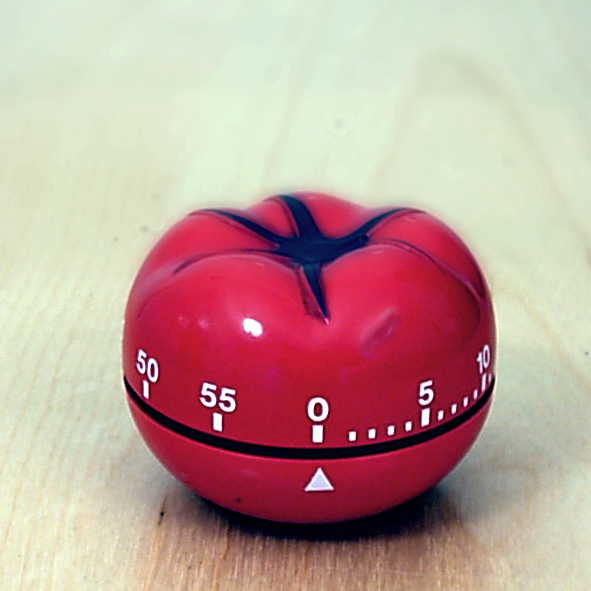
The Pomodoro Technique is a time management method developed by Francesco Cirillo in the late 1980s while he was a university student. The method uses a timer — originally a kitchen timer shaped like a tomato, hence the Italian name pomodoro — to divide work into fixed intervals, each followed by a short break. Despite its simple structure, the technique addresses several specific difficulties that arise in unscheduled home working environments.
Structure of the Method
A standard Pomodoro consists of 25 minutes of uninterrupted work followed by a 5-minute break. After completing four consecutive intervals, a longer break of 15 to 30 minutes is taken. Each completed interval is recorded, giving the worker a tangible count of sustained focus periods across the day.
The core constraint is that an interval cannot be paused. If an interruption occurs — a phone call, a household distraction, or an urgent message — the interval is either abandoned and restarted or treated as broken and noted separately. This strict rule forces a conscious decision about whether an interruption is worth the cost of losing the current session.
Application in Remote Work Contexts
Working from home introduces a category of interruption that does not typically exist in an office: the absence of a social contract around availability. In a shared office, colleagues observe that someone is at their desk, in a meeting, or on a call. At home, the default assumption for household members is often that the worker is available unless visibly occupied.
The Pomodoro Technique provides a practical boundary signal. When a timer is running, the decision to interrupt or respond to an incoming message is postponed to the next break. Workers who use a visible countdown — whether a physical timer or a software indicator — report that household members adapt to the rhythm relatively quickly.
In distributed teams operating across Polish time zones, the method also serves as a self-imposed communication boundary. Rather than responding to Slack or email messages within minutes of receiving them, a worker running Pomodoro cycles batches replies during breaks. This reduces reactive interruption and maintains the flow state required for complex analytical or writing tasks.
Interruption Tracking
Cirillo's original methodology includes a logging practice: workers record both internal interruptions (their own impulse to check a site, shift tasks, or seek information) and external ones (messages, calls, household interactions). After a week of tracking, patterns typically emerge — specific times of day, task types, or platforms that consistently break intervals.
The log is not about self-criticism. It is a diagnostic. Once the interruption pattern is visible, it can be addressed — not through willpower but through environmental adjustment.
Adapting Interval Length
The 25-minute default is a starting point, not a rule. Workers doing tasks that require extended ramp-up — such as debugging complex code, writing long-form documents, or conducting data analysis — often extend intervals to 45 or 50 minutes. Workers doing shorter, more varied tasks may find 20-minute intervals more sustainable.
What the technique emphasises is the ratio between work and break, and the completeness of each interval. An extended interval that ends with a deliberate break carries the same structural benefit as the standard 25-minute version. What it discourages is the unstructured work session that continues indefinitely without either a planned stop or a defined output.
Digital Implementations
Several timer applications are available that track Pomodoro sessions and log completed intervals:
- Pomofocus — browser-based timer with configurable session lengths and a simple daily log
- Forest — mobile application that grows a virtual tree during each session; abandoning the session kills the tree
- Be Focused Pro — macOS and iOS application with task-specific session tracking and export
- Toggl Track — time tracking application that can be combined with Pomodoro intervals for billable-hour logging
None of these applications change the method itself; they reduce friction by automating the timer and the log.
Documented Limitations
The technique is widely documented in productivity literature, but it is not universally effective. Tasks that require longer uninterrupted states — certain types of creative or research work — may be disrupted rather than aided by a 25-minute cutoff. Workers who manage asynchronous communication across multiple time zones may find that batching replies into break periods creates delays that are operationally unacceptable.
The method also does not address task selection. It provides structure for executing whatever task is in front of the worker, but it does not help in identifying which tasks should be prioritised. For that function, methods like the Eisenhower Matrix or Getting Things Done are better suited.